
Something significant is happening in the way students learn, and it is not happening in classrooms. It is happening at kitchen tables at midnight, in library corners during free periods, and on phones during commutes. Students who once stared at textbooks for hours and retained almost nothing are now moving through material faster, understanding it more deeply, and arriving at exams with a confidence that did not come from luck or natural ability. It came from using the right tools at the right moments. Artificial intelligence has entered the daily life of the modern student not as a futuristic novelty but as a genuinely practical set of tools that are changing what learning feels like when it actually works. This is not about replacing thinking. It is about removing the friction that gets in the way of it. Understanding how AI for student productivity actually functions, what it does well, where its limits are, and how to use it without losing the intellectual independence that education is supposed to build, is one of the most important things a student can understand right now.
The Real Problem AI Is Solving for Students Today
Before examining what AI tools can do, it is worth being honest about the problem they are solving. The modern student is not just dealing with difficult content. They are dealing with an overwhelming volume of competing demands on their attention, their time, and their emotional energy. They are managing coursework across multiple subjects simultaneously, often with no clear system for prioritizing or organizing the work. They are studying in environments saturated with digital distraction. They are receiving less individualized feedback than previous generations because class sizes are large and teacher time is finite. And they are expected to develop sophisticated skills in critical thinking, research, and communication largely by trial and error, with little explicit instruction in the process of learning itself.
AI tools address several of these problems simultaneously, and that multi-dimensional usefulness is what makes them genuinely transformative rather than merely convenient. A student who uses AI for student productivity is not just saving time on individual tasks. They are potentially restructuring their entire relationship with learning, from a passive and often anxious experience of absorbing information to an active and iterative process of engaging with ideas, testing understanding, and refining thinking. That shift in the fundamental character of the learning experience is what makes the best AI tools worth taking seriously.
The students who benefit most from AI tools are not the ones who use them to avoid work. They are the ones who use them to do better work, to push further into difficult material than they could alone, to get feedback on their thinking at two in the morning when no tutor is available, and to structure their study time in ways that actually align with how human memory and cognition function. These students are not cheating their education. They are optimizing it.
Why Traditional Study Methods Are No Longer Enough
Traditional study methods, re-reading notes, highlighting textbooks, writing out information repeatedly, were designed for a different educational environment. They worked reasonably well when the volume of information students needed to master was manageable, when the pace of curriculum was slower, and when the primary metric of educational success was the retention of factual information. None of those conditions describe contemporary education.
How AI Tools Transform the Way Students Study
The most direct and immediately impactful way AI tools improve learning is by transforming the quality and efficiency of study sessions. Traditional studying is often characterized by low cognitive engagement, a student sitting with material, moving their eyes across it, feeling like they are doing something productive while their brain is largely on standby. AI tools create conditions for the kind of active cognitive engagement that actually produces learning.
AI-powered flashcard systems like Anki with AI-generated decks, or dedicated platforms like Quizlet’s AI features, use spaced repetition algorithms to schedule review of material at precisely the intervals that research in cognitive science identifies as optimal for long-term retention. Instead of reviewing everything equally, which wastes time on well-known material and under-reviews difficult content, these systems direct a student’s attention precisely where it is most needed at exactly the right moment. The result is dramatically more efficient memorization and retention than any manual study schedule could produce.
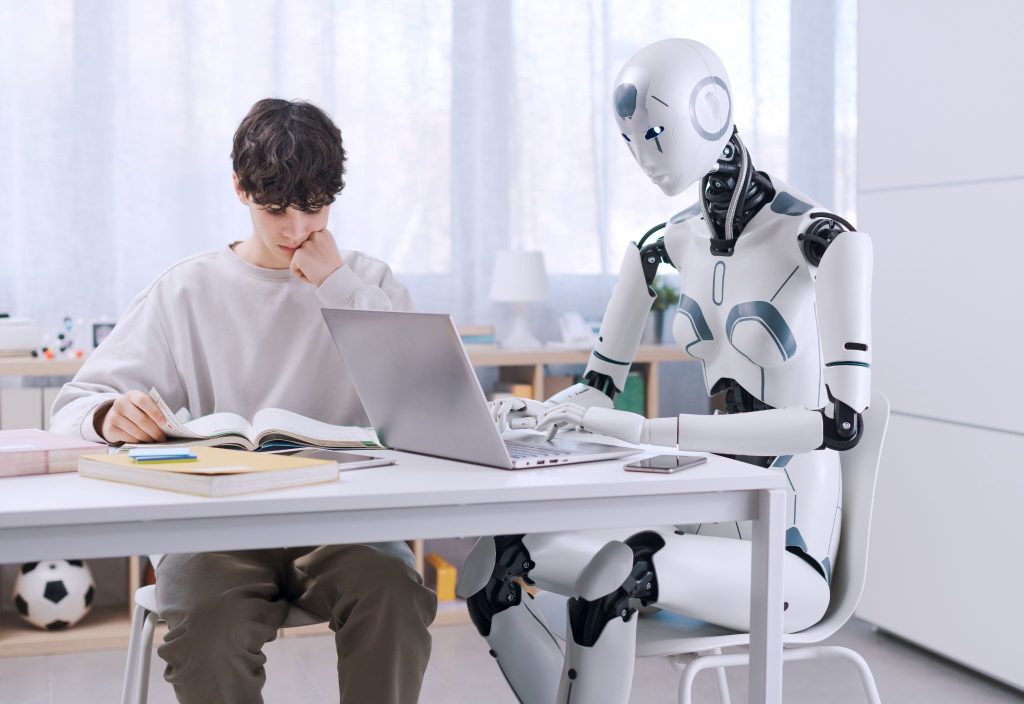
AI tutoring systems take this further by providing not just scheduling but genuine instructional support. Platforms that use conversational AI to explain concepts, answer questions, work through problems step by step, and identify misconceptions are giving students access to something that was previously available only to students whose families could afford private tutoring: responsive, patient, personalized instruction available at any hour. A student who gets stuck on a concept at ten o’clock on a Sunday evening no longer has to simply give up and hope the confusion resolves itself before the exam. They can engage with an AI tutor that will explain the concept as many times and in as many ways as necessary until understanding is achieved.
Personalized Learning Paths and Adaptive Content
One of the most significant limitations of traditional classroom education is that it delivers the same content in the same way at the same pace to every student, regardless of their individual starting point, their particular strengths and weaknesses, or their preferred way of engaging with new information. This one-size-fits-all approach is an institutional necessity in large classroom settings, but it is educationally inefficient for most students, who are either moving too fast through material they have not fully grasped or too slowly through material they have already mastered.
AI for student productivity at its most sophisticated creates genuinely personalized learning paths that adapt in real time to each student’s demonstrated understanding and performance. Adaptive learning platforms assess what a student knows through diagnostic questions, identify the gaps in their knowledge, and then generate a customized sequence of content and practice that addresses those specific gaps rather than following a predetermined curriculum regardless of fit. This adaptive approach can compress the time required to achieve genuine mastery of complex material significantly, because it eliminates the wasted time spent on content the student has already learned and focuses resources precisely where they are most needed.
The personalization extends beyond content selection to learning style accommodation. AI tools can present the same concept through multiple modalities, through text explanation, visual diagram, worked example, practice problem, and conversational dialogue, allowing students to find the approach that produces the clearest understanding for them individually. This flexibility is educationally valuable because it reflects the genuine diversity of the ways different people think and learn, a diversity that traditional educational content largely ignores.
AI-Powered Note-Taking and Information Processing
The process of transforming raw information from lectures, readings, and research into organized, usable study material is one of the most time-consuming and cognitively demanding parts of a student’s workload, and it is an area where AI tools offer substantial practical support. AI-powered note-taking tools can transcribe lectures in real time, generate structured summaries of long documents, extract key concepts and definitions from dense reading material, and organize information into formats that are optimized for review and retrieval.
Tools like Notion AI, Otter.ai, and various AI-enhanced note-taking applications allow students to capture information more completely during lectures, freeing cognitive resources that would otherwise be consumed by the mechanical process of writing to focus instead on understanding and engaging with the content being presented. The AI handles the transcription and initial organization while the student handles the thinking. This division of cognitive labor is both more efficient and more educationally sound than traditional note-taking, which often forces students to choose between capturing information completely and processing it meaningfully.
AI Tools for Writing, Research, and Academic Work
Academic writing is one of the areas where students most consistently struggle and where the gap between what is expected and what students feel equipped to produce is often largest. AI tools are reshaping this area in ways that are genuinely helpful when used appropriately and genuinely problematic when misused. Understanding the distinction is essential for any student who wants to benefit from AI writing tools without compromising their academic integrity or their development as a thinker and writer.
The appropriate use of AI in academic writing involves using AI tools to support and develop the student’s own thinking rather than to replace it. AI can be extraordinarily useful for helping students brainstorm and develop their arguments before they begin writing, suggesting angles they had not considered and asking questions that help them clarify their thinking. It can help students identify structural problems in their drafts, pointing out where the argument loses coherence, where a transition is needed, or where a claim requires more support. It can provide feedback on clarity and precision at the sentence level, helping students express their ideas more effectively without replacing those ideas with AI-generated content.
Using AI for Research Without Losing Critical Thinking
Research is another area where AI for student productivity offers significant benefits alongside significant risks. AI research tools can help students identify relevant sources, understand the landscape of scholarly conversation around a topic, and find connections between ideas across different fields and disciplines. Tools like Elicit, Consensus, and Perplexity AI are designed specifically to support academic research by surfacing relevant literature and summarizing scholarly findings in accessible language.
The risk in AI-assisted research is the potential for students to outsource not just the mechanical process of finding sources but the critical process of evaluating them. AI tools can identify relevant sources and summarize their contents, but they cannot reliably assess the quality, credibility, or relevance of those sources for a particular argument. They can tell you what a paper says but not whether it should be trusted or how its claims relate to the specific argumentative purpose you have in mind. Developing the skill of critical source evaluation is one of the most important things a university education is supposed to produce, and it is a skill that requires practice with real sources and real intellectual stakes rather than delegation to an AI system.
The most productive approach to AI-assisted research treats AI tools as a starting point rather than an endpoint. Use AI to identify the relevant sources, get an initial orientation to the scholarly conversation, and surface connections you might not have found independently. Then engage with those sources directly, critically, and with the full engagement of your own intellectual faculties. The AI expands your reach. Your own critical thinking determines what you do with what you find.
AI for Time Management and Academic Organization
Beyond its role in direct learning support, AI for student productivity extends to the organizational and logistical dimensions of academic life. Managing multiple courses, multiple deadlines, reading schedules, revision plans, and extracurricular commitments simultaneously is one of the most practically challenging aspects of being a student, and organizational failure is one of the most common contributors to academic underperformance at every level.
AI-powered planning and organization tools can help students build realistic schedules that account for the actual time different tasks require, that build in the spaced review sessions that research shows are essential for long-term retention, and that flag potential conflicts and bottlenecks before they become crises. AI tools can analyze a student’s workload across courses, identify the periods of highest demand, and suggest how to distribute preparation time most effectively. This kind of intelligent scheduling support can be the difference between a student who feels perpetually behind and one who feels genuinely in control of their academic life.
The Boundaries of AI and What Students Must Do Themselves
Honest discussion of AI for student productivity requires confronting its limits directly. AI tools are extraordinarily useful for a specific set of tasks: information retrieval and organization, pattern recognition, content summarization, procedural feedback, and scheduling optimization. They are significantly less useful and potentially harmful when they are used for tasks that require the development of genuine human intellectual capacity: forming original arguments, developing critical judgment, building the tolerance for intellectual struggle that is essential for deep learning, and developing the authentic personal voice that distinguishes a thinker from a processor of information.
The danger of over-reliance on AI tools is not that students will be caught cheating, though that risk is real and consequential. The deeper danger is that students will outsource the cognitive work that produces intellectual growth and arrive at the end of their education with credentials but without the thinking skills those credentials are supposed to represent. Learning is not primarily about acquiring information. It is about developing the capacity to think clearly, argue rigorously, evaluate evidence critically, and communicate ideas precisely. These capacities are developed through practice, through struggle, and through the sustained engagement with difficult material that AI tools, if misused, can allow students to avoid.
Final Thought
AI for student productivity is neither a magic solution nor a dangerous shortcut. It is a set of genuinely powerful tools that, like all tools, produce results that depend entirely on how they are used and for what purpose. The students who will benefit most from AI tools are not those who use them most aggressively but those who use them most wisely, keeping their own intellectual development at the center of every decision about when to use AI support and when to do the hard thinking themselves. Education has always been fundamentally about becoming a certain kind of person: curious, rigorous, capable of navigating uncertainty and complexity with honesty and skill. AI tools can support that becoming. They cannot substitute for it. And the students who understand that distinction clearly are already ahead, not because they have better tools, but because they know what tools are actually for.